Sunday, March 29, 2026

The A Bao A Qu Mystery

Fanciful depiction of the A Bao A Qu found on the internet

IN APRIL 1993 I received a strange request in the post. John Hagedorn - an American educationist-cum- percussionist then based in Alexandria, Egypt - wrote asking me to research the Malayan origins of the legend of "A Bao A Qu." Hagedorn's travel-writer colleague, Christopher Green, had unearthed this obscure tale from Jorge Luis Borges's 1967 Book of Imaginary Beings.

Borges claimed he had found the "A Bao A Qu" story in the appendix of C.C. Iturvuru's 1937 treatise, On Malay Witchcraft. I finally tracked down Borges's version of the "A Bao A Qu" story in the University of Malaya library - so I can vouch for the reliability of Green's succinct summary of this hoary tale:

To see the most lovely landscape in the world, a traveler must climb the Tower of Victory in Chitor

King Kumbhakaran
aka Rana Kumbha

[Green says he found on a map of India a town named Chitor. For what it's worth, there is indeed a town named Chittorgarh in Rajasthan province where the legendary warrior king Rana Kumbha constructed a Tower of Victory in 1448.]

A winding staircase gives access to the circular terrace on top, but only those who do not believe in the legend dare climb the tower.

On the stairway there has lived since the beginning of time a being sensitive to the many shades of the human soul known as A Bao A Qu. It sleeps until the approach of a traveler and some secret life within it begins to glow and its translucent body begins to stir. 

As the traveler climbs the stairs, the being regains consciousness and follows at the traveler's heels, becoming more intense in bluish color and coming closer to perfection. But it achieves its ultimate form only at the topmost step, and only when the traveler is one who has already attained Nirvana, whose acts cast no shadows.
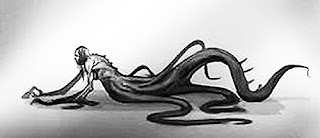
Otherwise, the being hesitates at the final step and suffers at its inability to achieve perfection

["Its moan is a barely audible sound, something like the rustling of silk."]

It tumbles to the first step as the traveler climbs down and collapses weary and shapeless, awaiting the approach of the next traveler.

In the course of the centuries, A Bao A Qu has reached the terrace only once.

For some reason I felt sure that C.C. Iturvuru (what an amazing name!) had heard the tale from an Orang Asli. The first person I asked happened to be Seri Pagi (though I only knew him as Pak Diap then). I gave him a simplified rendering of the A Bao A Qu legend and waited while the rusty gears of his memory whirred. His brow furrowed and then he broke into a broad grin, exclaiming in triumph: "Abang Aku! You mean Abang Aku!"

But of course. The way Orang Asli slur their vowels (especially in the states of Negri Sembilan and Pahang), Iturvuru might well have heard it as "A Bao A Qu." My Elder Brother, Abang Aku.*

I felt a jolt of electrifying knowledge. Diap said he remembered hearing a story similar to that when he was very young. It involved a spiral stairway connecting one dimension to another. A stairway once used by visiting or incarnating stargods. They say some got caught out by the calamitous closing of the interdimensional pathways. Once brilliant stars in their own universe, they fell to Earth and became ensnared in Time. Some of them ended up just like poor Abang Aku alias A Bao A Qu. A spirit fragment of cosmos caught in the gravity of human karma; a glorious starbeing lying inert at the bottom of the stairway to heaven, dependent on messy human destiny for its own fulfilment.

Only one other Elder seemed to have heard of Abang Aku. Village shaman Sibin Aus kept nodding sagely when I outlined the A Bao A Qu story to him. Then he smiled and said, “My Elder Brother is a reference to the Orang Asli. Our spirit will not be free until the younger races achieve nobility of purpose and purity of heart.”

Almost everyone, however, was familiar with the cryptic image of the long and winding stairway to the most wonderful view on Earth.

THE A BAO A QU MYTH evoked images of chakras - energy spirals operating on macro and micro levels - primordial forces attaining self-awareness, and nebulous notions of some deep alchemical mystery - an H.P. Lovecraftian vision of the strange, chthonic thoughtfields from which our familiar symbols sprout. 
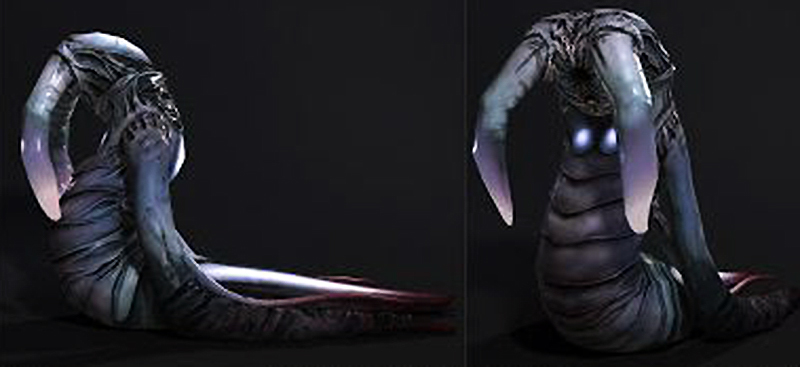

“Abang Aku” brought to mind the Great Old Ones, ancient squid-like beings central to Lovecraft’s Chthulu tales. (It also brought to mind Gurdjieff's Kundabuffer. This peculiar word was coined in the 1920s by the Greek-Russian magician-philosopher, G.I. Gurdjieff, to explain some "tragic flaw" in Man's genetic program which condemns him to futile lifetimes of Sisyphean** struggle, forever slipping back into robotic animality just when he's on the threshold of illumination. 

Some believe that this "Kundabuffer Effect" was deliberately installed by a somewhat insecure Creator God (or gods), to retard the evolution of human intelligence and thereby perpetuate a harnessable labor force on Earth. The Tower of Babel story lends credence to this notion of an "Almighty Father-God" who, feeling threatened by his mortal creatures' overweening ambitions, confounds them with a babble of tongues. Another scenario describes how humanity had its original 12-strand DNA reduced to two, to confine our consciousness within the physical world.)

I sensed that the A Bao A Qu story offered a key insight into the magical teachings of the Ancients. At some remote point in the infinite spiral of existence, an aspect of Spirit found itself trapped in a Promethean*** nightmare loop of recurring time. Only a self-realized and karma-free human could release the A Bao A Qu from its eternal yearning for perfection.

Tower of Victory in Chittorgarh,
Rajasthan, India

The Tower of Victory. Victory over death? Despair? Futility? The magic column of ascension, located in Chitor. Chita? Chita, cita, cinta, citta. Sanskrit for a quality difficult to define: essentially, citta means mindstuff, consciousness.

Chita or cita is closely related to cinta, romantic love - desire, emotions, feelings, longing, love, aspiration. (It could also, by invoking homophonic licence, be a slurring of cherita - nowadays spelled cerita - which means "story.") In effect one might describe chita as a poetic symbol for the Imagination, the Desiring Mind. But this is assuming it is related to Chitor, the town named in the legend of A Bao A Qu. And I assume it is, because myth is meant to be a malleable, dreamlike substance. 

The test of myth-entering keys lies in their emotive resonance when struck. Substituting “Abang Aku” for “A Bao A Qu,” “Chita” and “cerita” for “Chitor,” and “you” for “the traveler” - what do we get? A metaphysical conundrum that echoes in some barely remembered attic of our unconscious. A vague feeling of déjà vu, of “When did I dream this dream?” 

Was I the intrepid traveler, the hero, the messiah, redeemer of gooey amorphous geeks? Or was I Abang Aku himself, waiting eon upon eon for humanity to attain Buddha and Christ consciousness? Who else would have “already attained Nirvana,” whose acts would “cast no shadows” - in other words, be completely free of karmic consequences. And who might this Exalted Being be - if not our own Noblest Aspect, the Omega point of our Adamic Alpha?

That's why Abang Aku reaches perfection only once. However, his dream body or holoform remains embedded in the mythic realm as a timely trigger, to awaken anyone who chances upon the legend to the nature of his or her true purpose on this Earth.


______________

*  A. Ghani Ismail, an ardent scholar of Malay esoteric lore, offers some information which sheds a whole different light on the A Bao A Qu legend. He suggests that the phrase in question is actually a slurring of “Ibu Aku” (“My Mother”), explaining that in pre-Islamic Malay shamanism, the gateway to other dimensions was via an inner journey through the spiral staircase of the etheric umbilical cord which reconnects us with our pre-birth experience of oneness with the Mother. By voyaging beyond the point of our own conception, we break through the veils of time and space and regain cosmic consciousness. I thought this variation on the theme warranted inclusion, at least as a footnote.

** Sisyphean: from Sisyphus, in Greek mythology a cruel and cunning king of Corinth, who was punished in Hades by being made to roll a heavy boulder up a steep hill. Every time he got to the summit, the boulder would roll back down the hill, and Sisyphus had to repeat the process over and over forever.

*** Promethean: from Prometheus, in Greek mythology a first-generation god (or Titan) of Fire and Intellect, who returned the gift of Fire to Mankind (which Zeus the second-generation Olympian had withheld) - and for that was chained to a rock and his liver devoured by an eagle every day. Every night, the liver would regenerate and Prometheus would come back to life, only to have the eagle eat his liver all over again, and so on, ad infinitum. (It's less gory, but a lot scarier, when you approach this mythic morsel as a giant metaphor for compulsory reincarnation: Prometheus is the Soul, the rock is the physical world, the liver represents a lifetime, and the eagle is the emblem of Higher Authority or Spiritual Law. As a symbol, the eagle is interchangeable with the Indonesian garuda, the Chinese phoenix, the Mexican quetzal, or the Russian firebird, which represents Eternal Return. And Prometheus, the Fire-Bringer, is often identified with Lucifer, the Light-Bringer.) From the 'Management' point of view, Prometheus is a subversive element -  but 'Labor' would see him as a cult hero, a freedom fighter, a System-bucking Little Red Robin Hood!


The Ouroboros Effect

IF EVER ANYONE could establish beyond reasonable doubt that the legend of Abang (or Ibu) Aku originated in the mists of Malayan antiquity, specifically amongst the Orang Asli - it would indicate the high level of initiatory knowledge to which their ancestors had access.


An unexpected corroboration of my working theory about the basis of the Temuan myth system came about one day in 1995 when my mother-in-law Indah chanced upon an alternative metaphysics book I was reading (Nothing in This Book Is True, But It's Exactly How Things Are by Bob Frissell, Frog Ltd, 1994). On its cover was a montage showing a flying saucer fleet, the Face on Mars, the Barbury Castle crop circle of July 1991, and a couple of humanoid aliens that might have been Martian-Grey hybrids. Indah pointed excitedly at the alien figures and squealed, 'There! That's how the ancient sky gods looked!” I chuckled and asked her how she could possibly know. She said, “I know from the description I once heard as a child. My grandmother told us they were very tall and had large heads with enormous eyes.” Her husband Rasid looked at the book and nodded a wordless agreement. 

Well, such information is extremely difficult to verify. Perhaps Indah and Rasid had once seen a sci-fi film on TV and were keen to impress me with their breadth of understanding. I've found that even the most knowledgeable among the Temuan elders are rarely able to be specific about any of the old legends. (The fact is, Orang Asli generally don't place too high a value on specificity.) For instance, they seem reluctant or unable to explain the difference between Orang Halus and Orang Bunian (elves and fairies). 

Rasid told me there was yet another species of mythical folk known as Orang Alas: these were originally humans who had reverted completely to the wild. They were rarely seen because they had acquired extremely swift responses and would vanish when any outsider ventured too close. One might as well embark on a unicorn hunt than try and track down an Orang Alas. Some thought of the Orang Alas as spectral hunters, which they call hantu seburu.  

As for the Halus and the Bunian and the Lang Suir (harpies or sirens of the hills), and the huge compendium of hantu and other fourth-dimensional fauna mentioned in Temuan stories, one need look no further than the nearest coral reef to be reminded of nature's unfettered imagination when it comes to conjuring dream and nightmare forms. What was it the Master said about the infinite mysteries contained in a mustard seed?


WHEN I WAS IN BALI I was intrigued by depictions of the Tintya, the highest representation of divinity known to the Balinese. I believe the Tintya was inspired by the dancing Hindu god Shiva-Natarajah - but the Balinese form invariably shows the god enthroned on a fiery wheel or chakra, with cosmic energy shooting from every joint. In this day and age it would be impossible not to notice the Tintya's resemblance to the popular conception of an ET.

At a certain Balinese temple in Ubud I spoke with the guardian who disclosed that his predecessor had reported a Tintya visitation as recently as 1967 or 1969. There had been an unearthly light in the temple garden when the Tintya appeared.

So what do we make of these stories? Very little, going by the rules of empirical, mainstream analysis. However, if we take on board recent information relating to the unknown (read suppressed) history of the Earth, culled from various sources ranging from Zecharia Sitchin's maverick interpretations of Mesopotamian records and J.J. Hurtak's enigmatic Keys of Enoch, to “channeled” messages from “ascended masters” and a motley crew of “space brothers and sisters” - and then complement the data with our own restimulated “genetic memory” (most of us are quite capable of experiencing DNA flashbacks, though we tend to deny or recoil from such right-brained quantum jumps beyond the pre-programmed defines of our left-brained, linear thought-rails) - we may begin to perceive a much bigger pattern behind these fragments of myth. 

The crop circle phenomenon of the 1990s, for example, raises a few important questions: What is the special connection between prehistoric sacred sites and UFO sightings? How does our distant past relate to our immediate future?* Is our modern “scientific-materialistic” perspective wide enough to encompass the larger cosmic context in which we live? Why have historians and theologians been vacillating, for nearly two thousand years, between trying to regain and trying to suppress cosmological knowledge that was already well established in pre-Christian times? Perhaps the Ouroboros Effect (time swallowing itself in the form of a looped serpent), wherein the past meets and merges with the future in the present, will prove to be the single most valuable key to unlocking the Mystery of the Ages.


From The Cosmic Connection by Michael Hesseltine

________________

* Although the majority of crop circles have been geometric or pictographic, there have been instances of agriglyphic formations such as the one which appeared in mid-July, 1991, at the foot of Milk Hill at Stanton St Bernard in Wiltshire, England. It was a 120-foot long, 15-foot high hieratic inscription combining Iberian, Hebrew, and Phoenician letters - which experts have deciphered as a message from “The Creator, wise and kind.” The agriglyphs read: PH.EH.TH.I. (Phehthi) EA.E.CH.CH.E. (Ea-echche) - literally,”Ptah/Ea, Friend of Man.” (Ea/Enki, the Sumerian progenitor god of humanity, was called in Egypt, Ptah.)


Tribes of the Rainbow

THE STORY OF Mamak and Inak Bongsu and their seven children brings to mind a rainbow myth of the Zuni tribe of New Mexico. Introduced to the attention of the English-speaking world in 1888 by the controversial founder of Theosophy, H.P. Blavatsky, this Zuni legend was subsequently retold by Paedric Column in his 1930 book, Myths of the World: 

Among the Zuni people there is a god of the dawn and the evening called Paiyatuma, who is a talented flute player. Once upon a time, Paiyatuma brought to the Earth seven maidens decorated with feathers and magic wands, and he introduced them to our grandparents singing this chant:

The corn that you see, growing, rising,
Is the present of my seven bright maidens.
Never forget to feed and nourish them
And do never try to change their presents and offerings.
They represent the fertility of flesh in all human beings,
They carry the children of humanity.
Do never forget them or lose them,
You'll never find them again.

(from Rainbow Nation Without Borders by Alberto Ruz Buenfil, Bear & Co, 1991)

According to Zuni tradition, Paiyatuma gave their ancestors seven corn (maize) plants, each a different color. The Zuni elders expressed their gratitude for the seven maidens' gift of their flesh essence, which was to become the staple diet of the tribe. This gift was presented during an all-night ceremony in which “the seven maidens danced to the beat of drums and rattles” and to the chants of the Zuni elders. Each maiden danced with her corn plant, infusing it with her celestial spirit, so that when planted in the ground its seeds would always seek the sky. At dawn the seven maidens (or kachinas) discarded their feathers and wands and white robes, and emerged from their sacred space to mingle and dance with the people.  

From here on the tale gets a little complicated. One day, the medicine keepers and spiritual messengers of the Zuni heard an otherworldly music emanating from the top of Thunder Mountain. Following its irresistible call, they found themselves at the Rainbow Cave, where they beheld Paiyatuma playing his flute, accompanied by seven celestial maidens, who were also playing and dancing with their seven flutes. Totally enchanted by the glorious spectacle, the messengers urged Paiyatuma to return to Earth with these heavenly maidens. Paiyatuma explained: “These maidens are the same as yours, in the same way that the seven stars reflected in the lake are the same seven stars that you see in the sky. The only difference is that your seven maidens carry the seeds of corn, and these maidens carry only the water that allows your seeds to germinate.”

The tale winds on like a serpent, ending with a reprise of the rainbow corn ceremony with Paiyatuma and the seven musical sky maidens. Once more, they disappear after the chanting and all-night dancing, leaving the Zuni with instructions for seven human priestesses to preside over the annual corn dance. 

The myth doesn't explain why Paiyatuma became utterly displeased with the Zuni. His final statement sounds rather grim: “The rainbow maidens dressed in white will never return, because you humans have broken the contract that we had at the beginning of time.” 

But this is why even today the Zuni look upon corn seeds as sacred. When they plant the seeds, the whole village performs a ritual, mourning the departure of a dearly beloved one, and praying for her resurrection as a divine stalk of corn.


NOW A TEMUAN ELDER would have little trouble understanding the Zuni rainbow corn myth. Every fruit, every herb, root, and shoot, every boulder, every stream, every mountain, every bird and fish, every worm and insect, every single grain of sand is imbued with the essence of a sky goddess (Dewi) or princess (Tuan puteri) - and therefore must be honored as a sacred gift from Tuhan (God). Complex tales abound wherein divine beings “shapeshifted” themselves into a rainbow spectrum of edible or useful gifts. This is especially true of any grain or fruit that forms the tribe's staple diet.

To the Temuan, the amazing variety of culinary plants to be found in the rainforest was a divine endowment from Inak Bongsu, who transformed part of her essence into various delicious and nutritious fruits, to ensure that her children and their children's children did not go hungry. (“We value the durian,” Mak Minah said, “because its sweet, creamy flesh reminds us of heaven, and rightly so - for we are eating the divine flesh of Inak Bongsu.”) This largesse from Mamak and Inak Bongsu was granted prior to their leaving Tanah Tujuh for their original home - “beyond Pulau Buah, beyond Tanah Sejuk, beyond even the heavens, where no forms exist.”     

Everything around us is a gift, the Temuan elders say. Of course, it's rare these days to meet a Temuan who truly embodies these pristine ideals. The oldest resident of Kampung Pertak, Penengah Apak Busu Pegoi, was troubled by the fact that in recent generations many Temuan had forgotten their spiritual traditions. 

“Nowadays you'll even find people in our village throwing rubbish in the river,” he grumbled. “Even worse, some have started using poison to fish. Our great-grandparents taught us that the rivers issue from Gunung Rajah. They are like an eternal flow of mother's milk from the breast of Inak Bongsu giving us life and sustenance. How could we have discarded this knowledge so quickly?” 

Penengah's wife, Piah Agok, nodded in agreement. “Our grandparents knew so much more than we do,” she said softly.

Penengah Apak Busu Pegoi, at 90 the oldest man in Kampung Pertak, died on 30 April 1998.
This picture was taken by Antares a year earlier. His wife Piah Agok was the gentle mother 
of a large brood of 'rowdies.'


How the Moon Tricked the Sun and Won the Night

THE SUN AND THE MOON were colleagues and rivals in heaven. The Sun was excitable, showy and hotheaded while the Moon was cool and calm and fairly compassionate. They both had lots of children who cluttered the sky with a great clamor. 

The Moon noticed that the Sun’s offspring were fiery and hotheaded like their father. They caused the Earth to be so hot and troubled that no crops would grow, and Manusia was in serious danger of starvation. The Moon went into meditation and devised an ingenious plan: She hid all her children on her dark side and began to bulge visibly. The Sun came along and was amazed. “Hey, where’s your brood?” the Sun asked. “And how come you’re all alone?”

The Moon burped and answered with a broad grin: “I ate them and they were absolutely delicious!”  

The Sun, not to be outdone, immediately followed suit and devoured his children, every last one of them, until he too shone alone in the sky. Whereupon the Moon laughed and brought her little ones out from hiding and sent them out to play all over the night sky, where they turned into Stars. The Sun was furious but it was too late. He was all alone now and incapable of burning up the Earth with his hot temper. 

And every Night, the Earth would cool down enough for crops to grow and Manusia flourished from then on, thanks to the Moon’s cleverness and kindness.


Perah the Sacred Nut

BEFORE THE DAYS when they could go to a shop and buy cooking oil with money, the Temuan depended on the perah nut which produces a delicious, fragrant oil when dried and pounded and boiled into a paste and then smoked for a week in sealed bamboo tubes. The nut comes from a tropical hardwood much prized by the timber industry. It's becoming rarer and rarer to find a perah tree nearby since logging became a lucrative business. From afar you can spot a flowering perah by its striking red-orange-pink leaves. This usually means the nuts are already growing. The Temuan are particularly sad to see loggers cut down the perah trees. 

Indah explained: “We use the perah nut in so many ways. Boiled, it can be eaten like a cempedak or jackfruit seed. Powdered, it can be mixed with vegetables and fried - very tasty. And, of course, the perah nut was an essential source of cooking oil for our great-grandparents. We never chop down the perah tree, even though its wood is excellent for building. We believe that the perah was a special legacy from Inak Bongsu. When it came time for her to depart the Earth, she chose the form of the perah tree as an emblem of her eternal blessing. The perah grows in great abundance on the slopes of Gunung Rajah. It's a very sacred tree to us. We must sayang (cherish) the perah.”


Sulong and the Mango Tree

BUAH MACANG is a green-skinned, slightly acrid and very fibrous wild mango that tastes delicious with a dip of sweet, black soy-sauce and red-hot chilli peppers. Mak Minah tells a surrealistic tale of how this humble species of mango came to have such a distinctive flower.

Sulong, the firstborn child of Mamak and Inak Bongsu, found a heap of fallen buah macang under a tree. He sat down and began to peel one. It was blemished with worm trails, so he tossed it away and started on another. More worm trails! Sulong threw away the mango and picked up yet another. They all had worm trails, every single one. 

Terribly frustrated by now, Sulong decided he had to obtain the juiciest-looking and ripest mango from the very top of the tree. Gazing up he realized that the fruit was tantalizingly out of reach. He tried every method he could think of to bring down the fruit he desired. 

Finally, Sulong found himself transformed into a flower blooming at the crown of the macang tree. His powerful desire became its sensuous perfume; his disappointment, its acid taste.    

Is there a moral to the story? 

“Well, he shouldn't have made such a big fuss over a few worm trails,” said Mak Minah.  


How the Crocodile Got His Teeth

BUAYA THE CROCODILE was once a toothless creature that could only feed on insects and slugs.

Not so Keniling, the Pangolin, who was equipped with the most fearsome fangs imaginable, and delighted in climbing trees and lolling on branches, waiting for the next unsuspecting human to appear. Whereupon Keniling would let out a horrifying shriek and hurl himself fangs first upon the hapless victim, ripping through flesh and gulping down the mess with greedy slurps. Soon the human population of Tanah Tujuh was diminishing at an alarming rate. To Keniling, killing was merely a sport.
    
Buaya (who was mindful of Tuhan's laws and ate only when necessary) decided to do something about it. He went to visit Keniling with a sob story (could this be the origin of the expression, 'crocodile tears'?):
    
“O Keniling, my friend, how I envy you your very interesting and varied diet. Me? I have to content myself with a daily gruel of slugs and bugs in slime and slush!”
    
Keniling made a face and then sniggered. “Yuck! How very poetic! Serves you right, you toothless twit!”
    
Buaya let out a long, deep sigh. “Actually, I don't mind it all that much. At least the bugs are tasty. I bet they're much tastier than flesh.”
    
“No way,” smirked Keniling, “there's nothing that can beat the flavor of raw, succulent flesh - especially human flesh.”
    
“Well, I guess I'll never know what it's like,” said Buaya with an air of resignation. “For all I know, you may just be bragging about the wonderful taste of meat. Unless...” He paused thoughtfully, and then abruptly dismissed the thought. “Ah, forget it.”    
    
“Unless what?” Keniling asked, suddenly intrigued.
    
“Never mind, it was just a whim,” said Buaya, taking his leave.
    
“Unless WHAT?” demanded the Pangolin, leaping down from his tree.
    
Buaya smiled and put a conspiratorial arm around Keniling: “I was going to suggest that you lend me your teeth for a while, so that I can savor for myself the flavor of flesh and forever envy you.”
    
“Don't be ridiculous,” Keniling snorted. “How can I be sure you won't run off with my teeth?”
    
“I've got an idea,” Buaya said, unzipping his scaly hide. “I'll entrust you with my best suit of armor, if you'll let me try on your teeth for a week or two!”
    
Now, the Pangolin had long coveted Buaya's tough-looking jacket of finest crocodile skin. “Hold it! Let's see if it fits,” Keniling said, grabbing Buaya's beautifully tailored hide and putting it on.


With an expert eye, Buaya appraised Keniling in his borrowed suit of scales. Then he nodded his approval, saying: “Goodness me, I must say you strike a macho figure in that horny hide!”
    
Keniling was delighted to hear that. He removed his teeth and was about to hand them to Buaya, when he remembered what his father had taught him about business acumen. “Hold it jutht a thecond,” the Pangolin lisped toothlessly, “you can 'ave my teef for a week - but I get to keep your thuit for a MONTH!”
    
“Tho be it,” Buaya agreed, popping Keniling's enormous set of fangs into his own mouth. Then the two shook hands and parted.
    
A few days later, Keniling got hungry and he sought out Buaya to demand his teeth back, so that he could sink them into some human flesh. He found Buaya sunning himself by a river. “Thorry, the deal ith off,” the Pangolin whined, “I'm thtarving!”
    
“All right then, come and collect your bloody fangs,” shrugged Buaya. He waited till Keniling was within easy reach, and then clamped his great jaws on the Pangolin, who curled into a tight ball in shock (but was otherwise unhurt, thanks to the scaly armor he had on).
    
“Lemme go, lemme go!” shrieked Keniling, twisting helplessly in Buaya's grip. 
    
“Thay Uncle, you toofless terror!” mocked Buaya.

“Uncle! Uncle!” Keniling screamed, his voice muffled by his own tail.

“Louder,” hissed Buaya, tightening his vice-like grip.
    
“UNCLE! UNCLE!” the Pangolin pleaded. “You can 'ave your thuit back!”
    
Buaya tossed Keniling away with a nonchalant flip of his snout. “Keep it, I've got a whole wardrobe of scaly hides. And without any teeth you're certainly going to need a thick skin. Okay, Pangolin, your serial killing days are over. Now listen to 'Uncle' and go find yourself some nice juicy Ants!”
    
From that day on Keniling the Pangolin was known as the Scaly Ant-Eater. He never spoke again for fear his lisp would be ridiculed. And no matter how many millions of those tiny, crawling creatures he consumed, their population remained undiminished.


A Temuan folktale retold by Antares (from TANAH TUJUH ~ Close Encounters with the Temuan Mythos)
Year of composition: 2008;
Composer: Yii Kah Hoe;
Conductor: Joost Flach;
Performer: High Winds Ensemble;
Narrator: Tshiung Han See


Ogres and Giants

“There were giants in the earth in those days; and also after that, 
when the sons of God came in unto the daughters of men, and they bare children to them, 
the same became mighty men, which were of old, men of renown.” (Genesis 6:4)


WERE MAMAK AND INAK Bongsu giants?

“No, they were like us,” Mak Minah insisted. “But there was a race of ogres who suddenly appeared and caused a lot of trouble.”

Who were these ogres? Mak Minah could only say they came from “somewhere else, perhaps from across the ocean.”

Megasi - that's what the Temuan call these ogres which appear in Malay folklore as Gergasi - man-eating giants who weren't particularly intelligent. Rather like the Cyclops of Greek mythology who, though feared and loathed, often bore the brunt of much bawdy humor. In archeology, the gigantic stone walls of very ancient cities found in Mesopotamia, Mycenaea, Peru, and Mesoamerica have been labelled “cyclopean.” And justifiably so, for all the local folk legends testify that these incredible constructions were indeed the work of a giant race.

Mak Minah tells an amusing story about Inak Bongsu's abduction by a Megasi, and how Mamak Bongsu contrived to rescue her. (This brings to mind the Hindu epic Ramayana, which tells of Sita's abduction by Ravana, king of the Raksasas, and how Rama secured her safe release with the help of the warrior-monkey Hanuman). A great many details are missing from Mak Minah's account (she is more of a singer than a storyteller) and the only bit she remembers with great relish is when Mamak Bongsu transforms himself into a bamboo rat and hides amidst a grove of tender young shoots - a favorite snack of the Megasi when humans are unavailable.

When Mamak Bongsu hears the female giant’s heavy tread approaching, he attracts her attention by going “Whooo-ooo-whooo-ooo” in a very musical voice. The ogress is intrigued by this phenomenon: “How enchanting! The bamboo can sing!” she exclaims. Kneeling by the bamboo clump with her rump in the air, she tries to locate the source of the mysterious music. Whereupon Mamak Bongsu shapeshifts into a kumbang (carpenter bee) and buzzes straight into her huge vulva. Once inside, Mamak Bongsu stings her and her abdomen swells up.

Later her husband questions the ogress about her huge belly, and she declares that she has been impregnated by an enchanted clump of singing bamboo. (To this day, bamboo groves called buloh hibut or buloh perindu are known to sing enchantingly in the strong wind.)

Mamak Bongsu patiently waits till the Megasi’s husband has gone out hunting. Then he begins to slash at her stomach lining with his parang (it is unclear how he manages to smuggle a machete into her maw while disguised as a carpenter bee). Feeling sharp, stabbing pains in her belly, the ogress begins to roar, 

“Arrrgh, stomach upset, must shit right away!” The ogress squats to relieve herself and, in the process, Mamak Bongsu finds himself being forced out of her gargantuan backside. Thinking fast, Mamak Bongsu removes his teeth and hair (no problem for an experienced shapeshifter) so that the Megasi thinks she has just given birth to a baby ogre. 

“Hah! How lovely, my own little baby!” the ogress chuckles, and begins fussing over the “infant” Mamak Bongsu, cuddling the little tyke and tossing it in the air with whoops of delight. Then the Megasi notices that something is amiss and a deep frown furrows her enormous brow. At this point the ogress sings a crude little ditty which Mak Minah performs for me with risible glee:

Lambung tinggi-tinggi          Toss (the baby) high
Sampai hatap-hatap;             Right up to the roof;
Belum temu gigi,                   No sign of any teeth yet
Berbulu lubang pantat!         But, oh, such hairy pubes! 

No doubt the story ends happily with Mamak Bongsu killing the broody ogress, bushwhacking her husband and despatching him, and then freeing his beloved Inak Bongsu - but Mak Minah was so taken with the ogress's song, she kept repeating it over and over amidst peals of laughter from her audience, till everyone forgot that the tale wasn't quite done yet.

Nevertheless, it's cheering to know that the man-eating giants were eventually defeated and exiled far, far away, “beyond the most distant seas.”

Interestingly, Hindu mythology also speaks of terrible wars between the gods and the Asuras, a demonic race of warlike giants from a different world - a scenario echoed in the folk myths of many other cultures on the face of Tanah Tujuh.